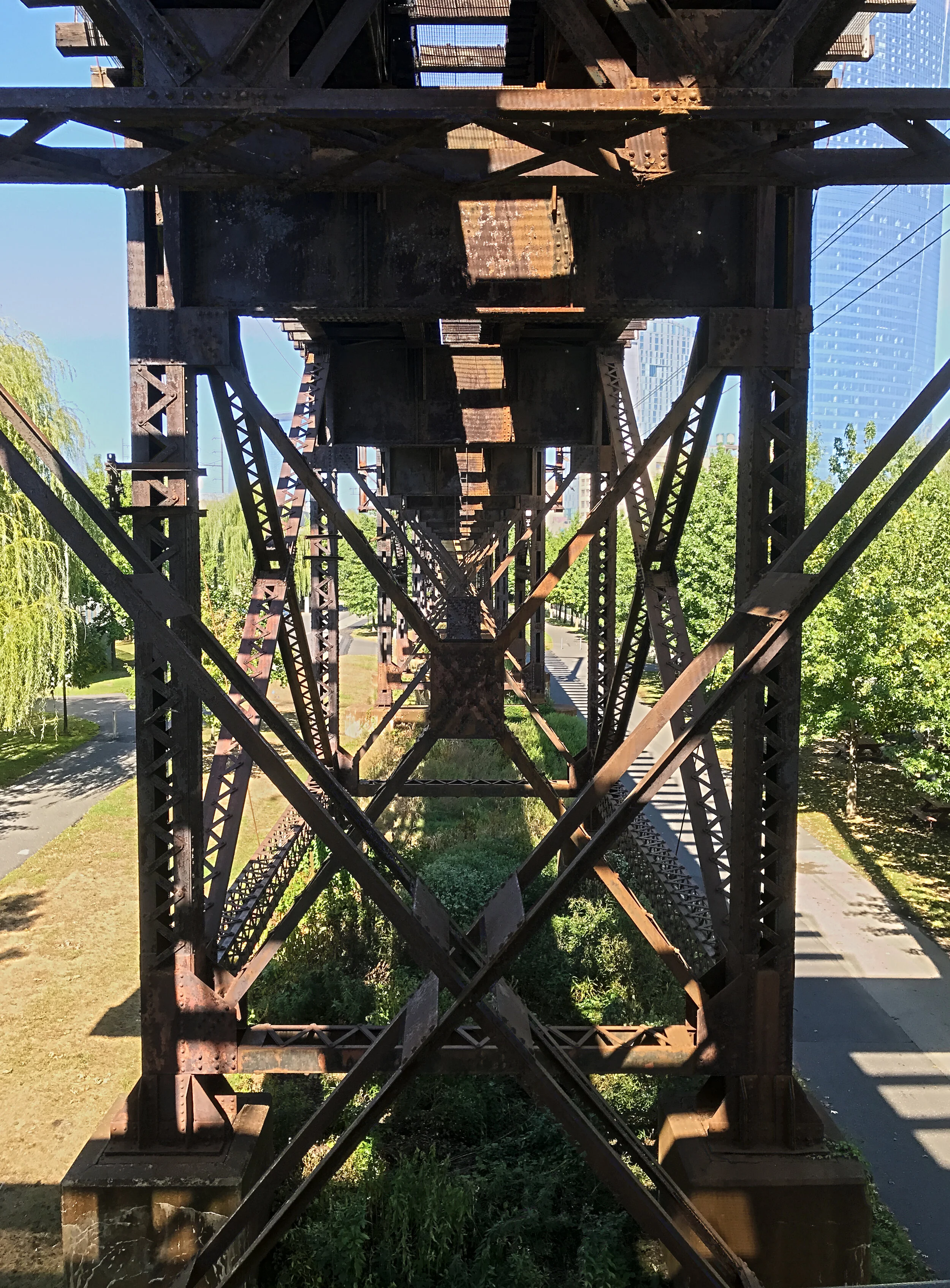
Curiosity and a critical perspective help me to see differently. This view is not uncommon to those on the Penn campus. Walking on the pedestrian bridge between Franklin Field and The Palestra, one need only look to the left and right. I am intrigued by the structural purity and raw quality that this elevated train exhibits. The raw material, worked by hand, but unfinished represents the efforts of laborers, ironworkers, riveters, and engineers of the past. I can’t help but recall Ruskin.
The mere presence of the train line adds a layer to the contemporary landscape. Obviously, it is historical, and certainly there are additional layers of history. But the history it foregrounds is specific—one of rail transport and industry. The proximity to other rail lines, industrial sites, and train stations all provide clues to the relationship of this elevated train to this site. Cities as built (and demolished) histories are effectively a series of layers. They are temporal, spatial, organizational and material. They give character. They color a sense of place. I find the section cut through those layers in hidden spaces. Their unmade quality offers a veritable glimpse at the past. I like to draw attention to these types of spaces for that reason. For you, the reader: look around next time you’re somewhere familiar. Look closely at places you know, but be sure to do it from a different perspective. Find something hidden, it may just provide you with a deeper understanding.